First Swiss–Polish Quantum Day strengthens cooperation between the two quantum ecosystems
Shaping the future. Entangled.
Around 60 representatives of the Swiss and Polish quantum communities gathered in Gdańsk on 10 September 2026 for the first Swiss–Polish Quantum Day, a new forum dedicated to strengthening bilateral cooperation in quantum science and technologies.
The event was organised in cooperation between the Embassy of Switzerland in Poland, the International Centre for Theory of Quantum Technologies (ICTQT) and the National Quantum Information Centre (KCIK), alongside the Q-Con Quantum Conference. It brought together representatives of academia, business, startups, public institutions and organisations supporting the development of quantum technologies.
The Swiss–Polish Quantum Day was opened by Prof. Marek Żukowski, Director of ICTQT, and Prof. Marcin Marciniak, Dean of the Faculty of Mathematics, Physics and Informatics at the University of Gdańsk. Participants were then welcomed by Luca Laloli, Head of Economic, Financial, Scientific and EU Affairs at the Embassy of Switzerland in Poland.
Understanding the Swiss and Polish quantum ecosystems
A key objective of the meeting was to better understand the strengths, structures and priorities of the two national quantum ecosystems.
Andreas Masuhr, Head of the Swiss Quantum Initiative at the Swiss Academy of Sciences, presented an overview of the Swiss quantum landscape, while Teodor Buchner from Warsaw University of Technology and Klaster Q – the Quantum Technologies Cluster introduced the Polish ecosystem.
These presentations provided a common starting point for the discussions that followed: where can Switzerland and Poland complement one another, what challenges do their quantum communities share, and which forms of cooperation could bring the greatest value?
The afternoon programme moved from presentations to active discussion through four parallel roundtables devoted to:
- building a functioning quantum ecosystem,
- moving R&D from the laboratory to industry,
- national platforms, infrastructure and services,
- trust, resilience and responsible innovation.
The roundtables were hosted by Ana Belen Sainz (ICTQT, University of Gdańsk), Jakub Jasiczak (PSC), Kilian Wasmer (armasuisse) and Justyna Pelc (ResQuant).
From ecosystem building to concrete cooperation
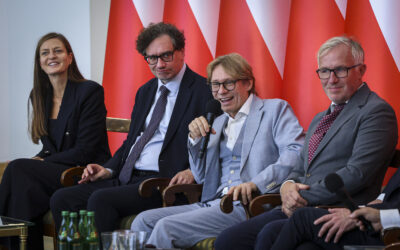
The day concluded with a panel moderated by Paweł Gora (Quantum AI), with the participation of Adam Gontarz (Swissmem), Hugo Lehmann (METAS), Rafał Duczmal (NCBR / EuroHPC JU) and Magdalena Stobińska-Moretto (University of Warsaw, QLAB).
The discussion focused on practical opportunities for Swiss–Polish cooperation, including collaboration between academia and business, existing good practices, national quantum strategies, current cooperation formats and new mechanisms that may still be needed.
An important part of the conversation concerned the complementarity of the two ecosystems and how international cooperation can help turn scientific excellence into stronger research networks, infrastructure, technologies and commercial opportunities.
The Polish side of the initiative was coordinated with the support of Paweł Gora, whose involvement helped connect participants from different parts of the national quantum community.
Quantum technologies in a broader international perspective
The Swiss–Polish Quantum Day formed part of a broader programme of activities surrounding Q-Con and Swiss–Polish cooperation in quantum technologies.
This included the GESDA Quantum Diplomacy Game, which introduced a global perspective by inviting participants to explore possible future challenges connected with the governance of emerging quantum technologies. The simulation highlighted that the development of quantum technologies is not only a scientific and technological issue, but also one involving international cooperation, security, regulation and strategic decision-making.
The bilateral Quantum Day then shifted the focus towards the concrete opportunities for collaboration between Switzerland and Poland.
Swiss experts also contributed to the wider Q-Con programme, sharing perspectives on topics including national quantum strategies, quantum security, commercialisation and scaling of quantum technologies.
Gdańsk as a meeting point
The programme began with a business lunch at Olivia Star, supported by InvestGDA. During the lunch, Piotr Grzelak, Deputy Mayor of Gdańsk, addressed the participants and welcomed the international quantum community to the city.
The meeting highlighted Gdańsk’s growing role as a place where scientific research, emerging technologies, business and international cooperation can meet.
Thank you to our partners and participants
The first Swiss–Polish Quantum Day would not have been possible without close cooperation between many people and institutions.
ICTQT and KCIK would like to thank the Embassy of Switzerland in Poland, and in particular Luca Laloli, for the cooperation in preparing the event.
We also thank Kainos and Patryk Jar for their support and cooperation in its organisation, InvestGDA for sponsoring the business lunch, and Paweł Gora for coordination and support on the Polish side.
Special thanks go to Andreas Masuhr and Teodor Buchner for presenting the Swiss and Polish quantum ecosystems, as well as to all speakers, panelists, roundtable hosts and participants for their time, expertise and open exchange of ideas.
With around 60 participants representing different parts of the Swiss and Polish quantum communities, the first Swiss–Polish Quantum Day demonstrated a clear interest in closer cooperation – from fundamental research and education to infrastructure, commercialisation, security and innovation.
The event created a strong foundation for continuing the dialogue and developing new connections between the two ecosystems.
Shaping the future. Entangled.