Did they really break quantum physics? – New PRL paper clarifies the debate about “Bell violation without entanglement”
A recent debate in the quantum physics community revolved around a provocative claim: that correlations resembling a violation of a Bell inequality might occur without quantum entanglement. The idea quickly attracted widespread attention, appearing not only in scientific discussions but also in popular science media and online commentary.
Researchers from the University of Gdańsk: Paweł Cieśliński (IFTiA MFI and ICTQT), Marcin Markiewicz (ICTQT), Konrad Schlichtholz (ICTQT), and Marek Żukowski (ICTQT) together with Jan-Åke Larsson from Linköping University, have provided a careful theoretical analysis showing that the situation is far less paradoxical than it initially appeared.
Their work, “Unquestionable Bell theorem for interwoven frustrated down conversion processes,” has been published in Physical Review Letters (Phys. Rev. Lett. 136, 090206, https://doi.org/10.1103/h2l1-fcz9). It preprint version can be download and viewed at arXiv: https://arxiv.org/pdf/2508.19207
What triggered the debate
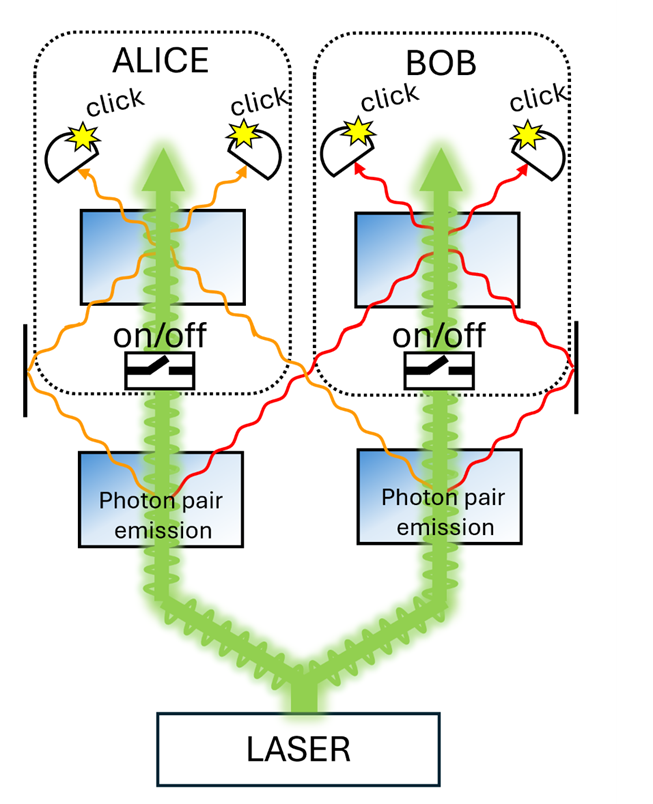
The discussion was sparked by an experiment reported in Science Advances titled “Violation of Bell inequality with unentangled photons” (https://www.science.org/doi/10.1126/sciadv.adr1794). The experiment used a complex interferometric configuration based on interwoven frustrated parametric down-conversion, where photons produced in multiple nonlinear crystals interfere due to path identity.
Because the interference patterns depend on phase settings in the interferometer, the authors interpreted the observed correlations as a possible violation of a Bell inequality without entanglement.
Such a result would be highly surprising. Since Bell’s theorem, violations of Bell inequalities have been regarded as a hallmark of quantum entanglement and nonclassical correlations.
Re-examining the Bell test
The new theoretical analysis shows that the apparent paradox arises from how the Bell test was formulated.
The authors demonstrate that when the experiment is analyzed using only phase shifts as measurement settings, the observed interference can be reproduced by a local realistic model. In other words, the correlations alone do not constitute a genuine Bell-inequality violation.
However, the same interferometric setup can reveal true Bell nonclassicality if the experiment is reformulated correctly. The key idea is to treat the nonlinear crystals located at the measurement stations as integral parts of the local measurement devices and to define measurement settings by switching the local pump fields on or off.
Under this formulation, the authors derive a standard Clauser–Horne Bell inequality and show that the predicted correlations do violate it, confirming the genuinely nonclassical nature of the process.
The analysis also demonstrates that the photons involved in the process cannot be considered truly unentangled, contrary to the original interpretation.
Beyond the original scenario
The same research line has already been extended further. In a follow-up work, “Bell-GHZ nonclassicality of many-observer interwoven frustrated down conversions” (https://arxiv.org/abs/2602.18381) the authors show that similar interferometric configurations can be generalized to multi-observer experiments, leading to GHZ-type tests of quantum nonlocality.
These results suggest that interwoven frustrated down-conversion may provide a versatile platform for exploring new forms of quantum interference and nonclassical correlations.
Clarifying, not breaking, quantum physics
The episode illustrates an important aspect of modern quantum research. As experiments probe increasingly sophisticated regimes, interpreting their results requires careful attention to the assumptions underlying Bell tests and measurement settings.
Rather than challenging the foundations of quantum mechanics, the new work clarifies how Bell’s theorem should be applied in complex interferometric experiments and reaffirms the central role of entanglement in Bell-inequality violations.
In short, despite dramatic headlines and lively public discussion, quantum physics remains perfectly intact.